

Bioactive Ingredients Market to Reach USD 105.94 Billion by 2035, Growing at 6.95% CAGR
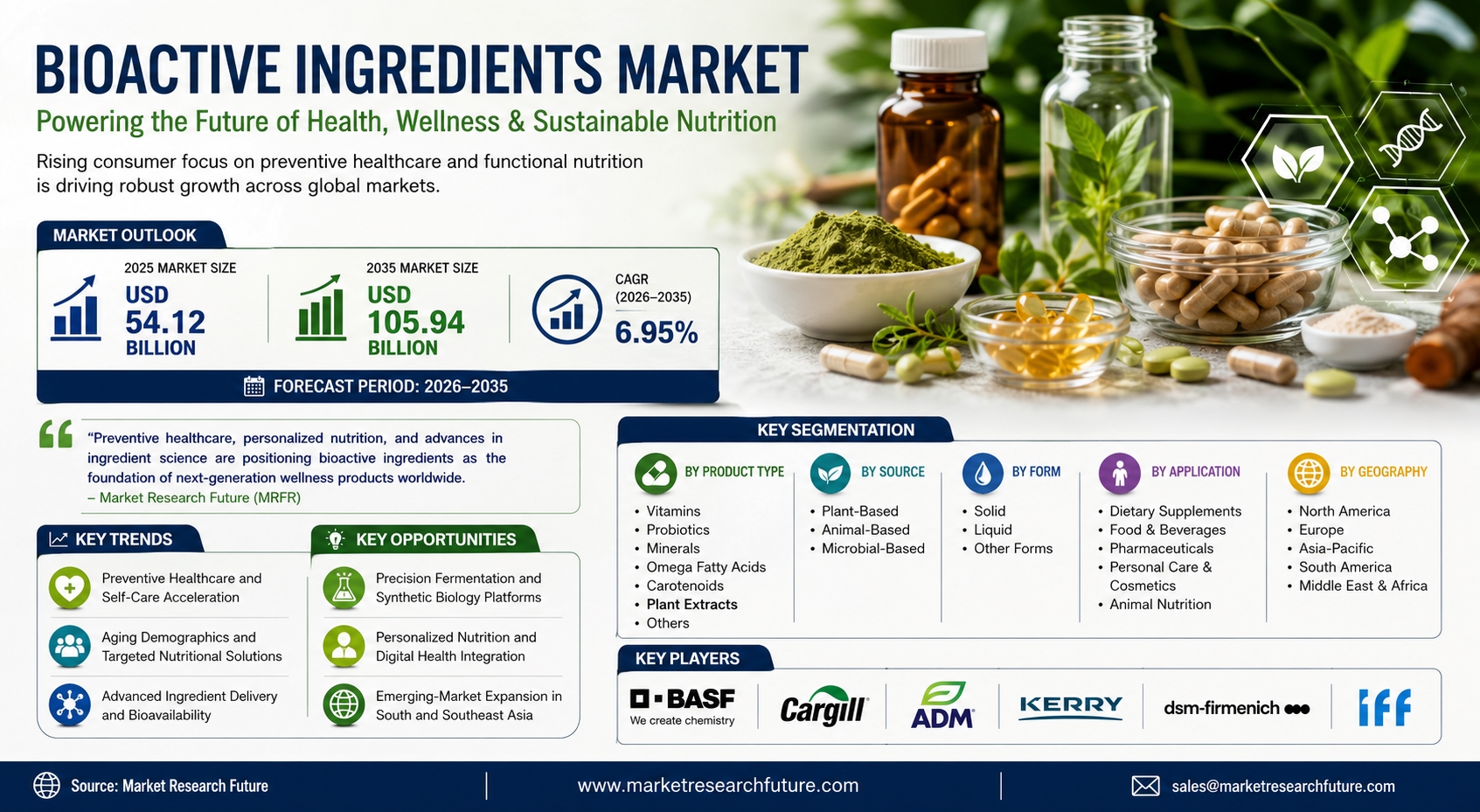
Bioactive ingredients market
Rising demand for preventive healthcare, personalized nutrition, and advanced delivery technologies is reshaping the global bioactive ingredients landscape.
Preventive healthcare, personalized nutrition, and advances in ingredient science are positioning bioactive ingredients as the foundation of next-generation wellness products worldwide.”
NEW YORK, NY, UNITED STATES, July 13, 2026 /EINPresswire.com/ -- The global Bioactive Ingredients Market is on a robust growth trajectory, with its valuation projected to expand from USD 54.12 billion in 2025 to USD 105.94 billion by 2035, registering a compound annual growth rate (CAGR) of 6.95% over the forecast period 2026–2035. This near-doubling of market value over the coming decade reflects a fundamental shift in consumer behavior toward preventive wellness, functional nutrition, and scientifically validated health solutions across food, beverage, dietary supplement, pharmaceutical, and personal care industries.— Market Research Future (MRFR)
Bioactive ingredients — a broad category encompassing vitamins, probiotics, minerals, omega fatty acids, carotenoids, plant extracts, and other functional compounds — have moved from the periphery of the health and wellness industry to its very center. Once considered niche additives reserved for specialty supplements, these ingredients are now core components of mainstream food formulations, clinical nutrition products, and cosmeceutical lines, driven by mounting scientific evidence of their physiological benefits and a global consumer base increasingly invested in proactive health management.
Market Overview: A Decade of Sustained Expansion
The bioactive ingredients industry sits at the intersection of nutrition science, biotechnology, and consumer health trends. As populations worldwide grapple with rising rates of chronic disease, an aging demographic profile, and heightened awareness of the gut-immune-brain connection, demand for ingredients that deliver measurable, targeted health outcomes has surged. The market's projected CAGR of 6.95% through 2035 signals sustained, structural demand growth rather than a short-term pandemic-driven spike, suggesting that bioactive ingredients have become embedded in long-term dietary and lifestyle patterns across both developed and emerging economies.
This growth is further underpinned by continuous innovation in extraction, encapsulation, and fermentation technologies that allow manufacturers to deliver higher-purity, higher-bioavailability ingredients at increasingly competitive price points. As a result, bioactive ingredients that were once cost-prohibitive for mass-market applications are now finding their way into everyday food and beverage products, expanding the addressable market well beyond the traditional supplement aisle.
Get Full PDF Sample Copy of Report: (Including Full TOC, List of Tables & Figures, Chart) @ https://www.marketresearchfuture.com/sample_request/5371
Market Segmentation: Diverse Applications Across Product Types, Sources, and Forms
The Bioactive Ingredients Market report from Market Research Future segments the industry across four principal dimensions, each offering a distinct lens into where growth is concentrated.
By Product Type, the market spans Vitamins, Probiotics, Minerals, Omega Fatty Acids, Carotenoids, Plant Extracts, and other specialty compounds. Vitamins and minerals continue to serve as foundational categories given their established regulatory pathways and broad consumer familiarity, while probiotics and omega fatty acids have emerged as high-growth segments propelled by expanding research into gut microbiome health and cardiovascular and cognitive wellness. Plant extracts, meanwhile, are benefiting from the global "clean label" movement, as consumers increasingly favor ingredients perceived as natural, minimally processed, and traceable to their botanical origins. Carotenoids, valued for their antioxidant properties and roles in eye health and immune support, are also gaining traction in both nutraceutical and cosmetic applications.
By Source, the market is categorized into Plant-Based, Animal-Based, and Microbial-Based ingredients. Plant-based bioactives are experiencing outsized demand growth as the broader plant-based and flexitarian consumer movement intersects with functional nutrition, while microbial-based ingredients — including those derived from precision fermentation — represent one of the fastest-evolving frontiers in the industry, offering scalable, sustainable, and highly customizable production pathways that reduce dependence on agricultural land and animal-derived inputs.
By Form, the market is divided into Solid, Liquid, and Other Forms. Solid forms, including powders, tablets, and capsules, remain dominant due to their stability, ease of transport, and compatibility with existing supplement and food manufacturing infrastructure. Liquid forms are gaining share, particularly in functional beverages and ready-to-drink formats, as consumers seek convenient, fast-absorbing delivery mechanisms that fit into increasingly mobile lifestyles.
By Application, the market serves Dietary Supplements, Food & Beverages, Pharmaceuticals, Personal Care & Cosmetics, and Animal Nutrition. Dietary supplements remain a core revenue driver, but the food and beverage sector is emerging as a critical growth engine as manufacturers fortify everyday products — from snacks to dairy alternatives — with functional ingredients. Personal care and cosmetics represent a fast-growing frontier as the "beauty-from-within" concept gains momentum, blurring the lines between ingestible and topical wellness products. Animal nutrition also constitutes a meaningful and expanding application area, as livestock and companion animal nutrition increasingly mirror human health trends.
By Geography, the market spans North America, Europe, Asia-Pacific, South America, and the Middle East & Africa. North America and Europe remain mature, high-value markets characterized by sophisticated regulatory frameworks and high consumer willingness to pay for premium functional ingredients. Asia-Pacific, however, is poised to be a primary growth engine over the forecast period, driven by expanding middle-class populations, rising disposable incomes, and deepening consumer awareness of preventive health practices.
Key Trends Shaping the Market Through 2035
The Market Research Future report identifies six defining trends that will shape the trajectory of the bioactive ingredients industry over the next decade.
Preventive Healthcare and Self-Care Acceleration. Consumers worldwide are increasingly prioritizing proactive health management over reactive treatment, driven by rising healthcare costs, greater health literacy, and a post-pandemic emphasis on immune resilience and overall wellbeing. This shift is fueling sustained demand for bioactive ingredients that support daily wellness routines rather than addressing acute illness alone.
Aging Demographics and Targeted Nutritional Solutions. With the global population of adults aged 60 and above continuing to expand rapidly, particularly across North America, Europe, and increasingly East Asia, demand is intensifying for bioactive ingredients targeted at age-related health concerns — including bone density, joint health, cognitive function, and cardiovascular wellness. This demographic shift is prompting manufacturers to develop increasingly specialized formulations tailored to older consumers' physiological needs.
Advanced Ingredient Delivery and Bioavailability. A growing body of research has highlighted that the efficacy of many bioactive ingredients is limited not by their inherent potency but by poor bioavailability and absorption. In response, manufacturers are investing heavily in advanced delivery technologies — including microencapsulation, liposomal delivery, and nanoemulsion systems — that enhance the stability, solubility, and physiological uptake of key compounds, thereby improving consumer-perceived efficacy and driving premiumization across the category.
Precision Fermentation and Synthetic Biology Platforms. Biotechnology is fundamentally reshaping how bioactive ingredients are produced. Precision fermentation and synthetic biology platforms now allow companies to produce complex bioactive compounds — including specialty proteins, vitamins, and lipids — with greater consistency, scalability, and sustainability than traditional extraction or animal-derived methods. This technological shift is lowering production costs over time while simultaneously addressing growing consumer and regulatory demand for more sustainable, traceable supply chains.
Personalized Nutrition and Digital Health Integration. The convergence of digital health technologies, genetic testing, and microbiome analysis is enabling a new era of personalized nutrition, in which bioactive ingredient formulations are increasingly tailored to individual consumer profiles rather than designed for broad population averages. Wearable health devices, at-home testing kits, and AI-driven nutrition platforms are creating new distribution and engagement channels for bioactive ingredient manufacturers, opening pathways to direct-to-consumer personalized supplement models.
Emerging-Market Expansion in South and Southeast Asia. As disposable incomes rise and urbanization accelerates across South and Southeast Asian markets, including India, Vietnam, Indonesia, and the Philippines, demand for functional food, beverage, and supplement products is growing rapidly. Local manufacturers and multinational players alike are investing in region-specific product development and distribution infrastructure to capture this expanding consumer base, positioning the region as a critical growth frontier for the industry over the coming decade.
Competitive Landscape: Global Leaders Driving Innovation
The Bioactive Ingredients Market remains characterized by the presence of several well-established multinational players with deep expertise in ingredient science, global supply chain infrastructure, and regulatory navigation. Key companies profiled in the report include BASF SE, Cargill, Inc., ADM, Kerry Group, dsm-firmenich, and IFF.
These industry leaders are pursuing a range of strategic initiatives to strengthen their market positions, including sustained investment in research and development, strategic acquisitions of specialty ingredient producers, expansion of production capacity in high-growth regions, and partnerships with academic and clinical research institutions to generate the scientific evidence increasingly demanded by both regulators and health-conscious consumers. Many of these companies are also investing in sustainability initiatives, including traceable sourcing programs and lower-carbon production methods, as environmental, social, and governance (ESG) considerations become an increasingly important factor in both business-to-business procurement decisions and end-consumer purchasing behavior.
Beyond these established players, the market is also witnessing growing activity from agile biotechnology startups specializing in precision fermentation and novel bioactive compound discovery, which are increasingly attracting strategic investment and partnership interest from larger incumbents seeking to diversify their ingredient portfolios and accelerate innovation timelines.
Regional Dynamics
North America continues to represent one of the most mature and high-value regional markets for bioactive ingredients, supported by well-established dietary supplement and functional food industries, sophisticated retail and e-commerce infrastructure, and a regulatory environment that, while rigorous, provides reasonably clear pathways for ingredient approval and health claim substantiation.
Europe similarly represents a significant market, characterized by stringent regulatory oversight through frameworks such as the European Food Safety Authority's (EFSA) health claims regulations, which, while creating a higher bar for market entry, also lend significant credibility to approved products and ingredients. European consumers have shown particularly strong demand for plant-based and sustainably sourced bioactive ingredients, aligning with the region's broader environmental consciousness.
Asia-Pacific is expected to emerge as the fastest-growing regional market over the forecast period, driven by a combination of rising incomes, expanding urban middle classes, increasing prevalence of lifestyle-related health conditions, and growing consumer sophistication around functional nutrition. Markets including China, Japan, South Korea, and India are each contributing distinct growth dynamics, from Japan's long-established functional food (Foods for Specified Health Use, or FOSHU) regulatory framework to India's rapidly expanding nutraceutical sector.
South America and the Middle East & Africa, while currently representing smaller shares of the global market, are demonstrating meaningful growth potential as rising health awareness, expanding retail infrastructure, and growing multinational investment gradually build out functional ingredient ecosystems in these regions.
Market Drivers and Opportunities
Several structural factors underpin the sustained growth outlook for the bioactive ingredients industry. Rising global prevalence of chronic conditions such as cardiovascular disease, type 2 diabetes, and obesity is driving demand for ingredients scientifically associated with risk mitigation and metabolic health support. Simultaneously, growing scientific understanding of the gut microbiome's role in immune function, mental health, and overall wellbeing continues to fuel demand for probiotic and prebiotic ingredients.
The broader clean-label and natural ingredient movement is also creating opportunities for plant-based and minimally processed bioactive ingredients, as consumers increasingly scrutinize ingredient lists and favor products perceived as close to their natural source. Meanwhile, advances in extraction and fermentation technology are steadily reducing production costs for previously premium-priced ingredients, expanding their addressable market into mainstream and mass-market product categories.
Emerging opportunities are particularly notable in precision fermentation, which offers a scalable and increasingly cost-competitive alternative to traditional plant extraction and animal-derived sourcing methods, and in personalized nutrition platforms, which open new direct-to-consumer revenue models for ingredient and finished-product manufacturers alike.
Market Restraints and Challenges
Despite the positive growth outlook, the industry faces several notable challenges. Regulatory complexity remains a significant barrier, as health claim substantiation requirements vary considerably across regions and often require substantial clinical investment before ingredients can be marketed with specific functional claims. Supply chain volatility, particularly for plant-derived ingredients subject to agricultural and climate variability, also poses ongoing risk to production consistency and pricing stability.
Additionally, as consumer awareness grows, so too does scrutiny of ingredient efficacy claims, placing pressure on manufacturers to invest in robust clinical research to substantiate product benefits and differentiate credible offerings from less rigorously supported alternatives in an increasingly crowded marketplace.
Outlook
With the market projected to nearly double in value from USD 54.12 billion in 2025 to USD 105.94 billion by 2035, the bioactive ingredients industry is positioned for a decade of sustained, technology-driven growth. Companies that successfully combine scientific rigor, sustainable and scalable production methods, and consumer-centric innovation — particularly around personalization and enhanced bioavailability — are likely to capture disproportionate share of this expanding market. As preventive healthcare continues to reshape global consumer priorities, bioactive ingredients are set to play an increasingly central role in the future of food, nutrition, and personal care.
Discover Related Research Reports By Market Research Future:
Protein Ingredients Market
https://www.marketresearchfuture.com/reports/protein-ingredients-market-1244
Cocoa Ingredients Market
https://www.marketresearchfuture.com/reports/cocoa-ingredients-market-1380
Dairy Ingredients Market
https://www.marketresearchfuture.com/reports/dairy-ingredients-market-1808
Sagar Kadam
Market Research Future
+1 628-258-0071
email us here
Legal Disclaimer:
EIN Presswire provides this news content "as is" without warranty of any kind. We do not accept any responsibility or liability for the accuracy, content, images, videos, licenses, completeness, legality, or reliability of the information contained in this article. If you have any complaints or copyright issues related to this article, kindly contact the author above.
