

Generic Drugs Market Projected to grow US$ 942.69 billion by 2033, Forecast, Drivers, and Key Opportunities
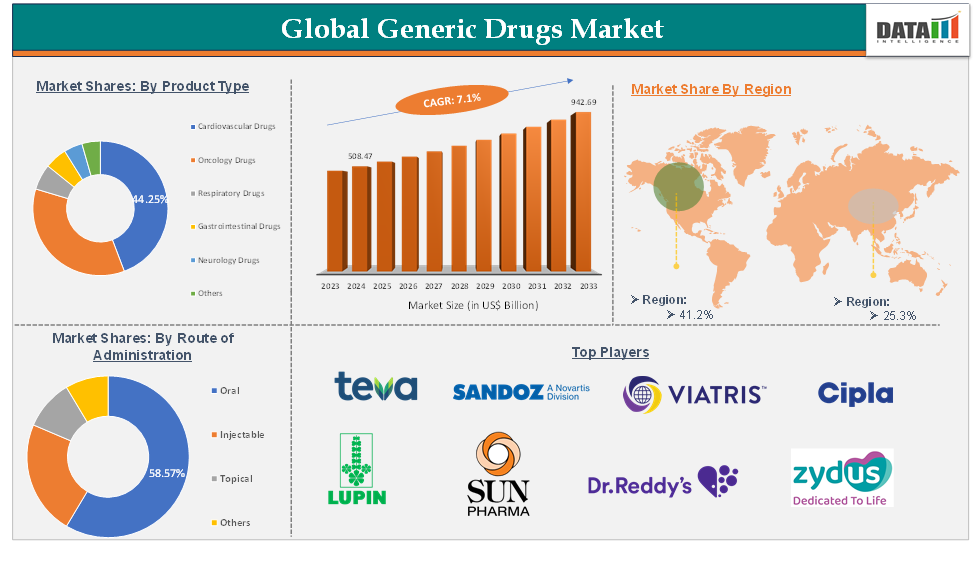
Generic Drugs Market Size
Generic Drugs Market Outlook: What Investors, Pharma Giants, and Entrepreneurs Need to Know
Pharma Investment Alert: Generic Drugs Market Forecast, Drivers, and Key Opportunities”
AUSTIN, TX, UNITED STATES, February 11, 2026 /EINPresswire.com/ -- Market Size and Outlook— DataM Intelligence 4Market Research LLP
Global Generic Drugs Market Enters a High-Growth Phase Driven by Rising Demand for Affordable Medicines, Expanding Chronic Disease Burden, and Government Cost-Containment Policies.
Increasing healthcare expenditure pressures, wider adoption of bioequivalent medicines, and supportive regulatory pathways for generic approvals are propelling the global generic drugs market toward US$ 797.4 billion
AUSTIN, Texas and TOKYO, February 11, 2026: The global generic drugs market is witnessing sustained growth, supported by rising demand for cost-effective therapies and expanding access to essential medicines across both developed and emerging healthcare systems.
Get a Sample PDF Of This Report (Get Higher Priority for Corporate Email ID):- https://www.datamintelligence.com/download-sample/generic-drugs-market
According to data from the U.S. Food and Drug Administration (FDA), generic medicines accounted for over 90% of all prescriptions dispensed in the United States in 2023, highlighting the strong penetration of generics in mature pharmaceutical markets. The market was valued at approximately US$ 460.64 billion in 2025 and is projected to reach US$ 797.4 billion by 2033, expanding at a CAGR of 7.1% during the forecast period, driven by patent expirations, increasing chronic disease prevalence, and strong policy support for cost-efficient drug procurement.
Growth is further supported by broader public-health and policy trends aimed at reducing pharmaceutical spending. The World Health Organization (WHO) reports that noncommunicable diseases account for around 74% of global deaths, creating sustained demand for long-term therapies where generics play a critical role in affordability and accessibility. In addition, European Commission data indicate that generic medicines generate savings of tens of billions of euros annually for European healthcare systems, enabling reinvestment into innovative therapies and public health programs. The continued expansion of universal healthcare coverage, tender-based procurement systems, and essential medicines programs is reinforcing the role of generic manufacturers as key suppliers in the global pharmaceutical ecosystem.
Request for Customized Sample Report as per Your Business Requirement:- https://www.datamintelligence.com/customize/generic-drugs-market
Rising Cost-Containment Pressure and Government Policies Favoring Generics
Governments and public health systems are increasingly promoting generic medicines to control pharmaceutical expenditure, directly strengthening demand for the global generic drugs market. The U.S. FDA reports that generic medicines account for about 90% of all prescriptions dispensed in the United States, demonstrating the scale at which healthcare systems rely on low-cost alternatives to branded drugs.
In addition, the Association for Accessible Medicines (AAM) estimates that the use of generics generated about US$2 trillion in healthcare savings in the U.S. over a ten-year period, highlighting the economic importance of substitution policies and reimbursement incentives. Many national procurement programs, tender systems, and essential-medicines lists, particularly in emerging markets, prioritize generics to expand access to treatment, which continues to drive sustained volume growth worldwide.
Small-Molecule Generics Segment Drives Demand in the Global Generic Drugs Market
The small-molecule generics segment dominates demand because most essential medicines used in primary care, antibiotics, cardiovascular drugs, diabetes therapies, and analgesics are chemically synthesized and widely off-patent.
According to the U.S. FDA, the agency approved more than 900 generic drug approvals and tentative approvals in 2023, reflecting sustained demand for chemically synthesized generics across therapeutic areas. These approvals and high utilization rates continue to expand the availability of affordable medicines globally, especially in chronic disease management.
Government procurement and public health programs further strengthen this segment’s growth. The Government of India reports that over 9,000 Jan Aushadhi Kendras are operational, supplying low-cost generic formulations of essential small-molecule medicines to millions of patients under national affordable-medicine initiatives. Public health agencies also emphasize the economic value of generics; U.S. healthcare system analyses indicate that generics generate hundreds of billions of dollars in annual savings, helping sustain reimbursement programs and expand patient access.
In recent developments, regulatory agencies in multiple countries have accelerated approvals for complex generics and modified-release formulations, enabling manufacturers to enter higher-value segments while maintaining the cost advantages of small-molecule production.
Asia-Pacific Emerges as a Major Demand Center for Generic Drugs Driven by High Disease Burden and Expanding Public Healthcare Programs
Asia-Pacific is witnessing strong demand for generic drugs driven by the high burden of chronic and infectious diseases and expanding public healthcare coverage. The World Health Organization reports that noncommunicable diseases account for more than 70% of deaths in the South-East Asia and Western Pacific regions, increasing long-term demand for affordable medicines.
Governments across India, China, and Indonesia are strengthening national insurance and essential-medicine procurement programs that prioritize generics to control treatment costs. India’s Department of Pharmaceuticals also reported continued expansion of production under public health schemes and generic pharmacy initiatives, supporting wider access to low-cost medicines across urban and rural populations.
The region is also growing rapidly due to its role as a global manufacturing hub for generic medicines and active regulatory reforms. India’s Ministry of Commerce and Industry reports that pharmaceutical exports reached about US$ 27–28 billion in FY2023–24, with generics accounting for a major share of shipments to regulated and semi-regulated markets.
China’s volume-based procurement program continued expanding in 2023–2024, significantly increasing hospital adoption of low-cost generics and reducing prices of selected drugs by large margins in public tenders. Recent investments in API self-sufficiency, plant modernization, and cross-border partnerships by Asian manufacturers are further strengthening production capacity and accelerating regional market growth.
Competitive Landscape and Strategic Developments
The global generic drugs market is highly competitive and characterized by a mix of large multinational manufacturers and cost-efficient regional producers. Companies such as Teva Pharmaceutical Industries Ltd., Sandoz Group AG, Viatris Inc., Sun Pharmaceutical Industries Ltd., and Fresenius Kabi AG compete primarily on pricing, manufacturing scale, regulatory approvals, and complex-generic development capabilities.
Large players are increasingly focusing on biosimilars, injectables, and difficult-to-manufacture generics to differentiate portfolios and protect margins. Industry trends also show rising strategic partnerships, portfolio rationalization, and geographic expansion, particularly in the U.S., Europe, and emerging Asia markets, where demand for affordable medicines continues to grow.
Key Developments:
• In December 2025, Pfizer entered into an exclusive marketing and distribution partnership with Cipla for select established brands in India, including Corex Dx, Corex LS, Dolonex, Neksium, and Dalacin C. Under the agreement, Pfizer will continue manufacturing and supplying the products, while Cipla will handle marketing, distribution, and sales through its extensive domestic network. The collaboration is expected to significantly expand patient access across India and improve reach in tier-2 and tier-3 markets. This asset-light strategy enables Pfizer to enhance market penetration while strengthening Cipla’s portfolio in key therapeutic segments.
• In October 2025, Algorae Pharmaceuticals partnered with Cadila Pharmaceuticals under a proposed license and supply agreement to introduce two generic medicines in Australia and New Zealand. The products will target high-demand cardiovascular and metabolic therapy areas, with Cadila supplying medicines from its globally accredited manufacturing facilities. Algorae will manage TGA registration and commercialization following execution of the definitive agreement. The collaboration strengthens Algorae’s regional presence while leveraging Cadila’s regulatory expertise and large-scale manufacturing capabilities.
Buy Now & Unlock 360° Market Intelligence:- https://www.datamintelligence.com/buy-now-page?report=generic-drugs-market
Leading Company Profiles and Strategic Developments
Sun Pharmaceutical Industries Ltd. is one of the world’s largest specialty generic pharmaceutical companies, headquartered in Mumbai, India. The company develops and manufactures a wide range of formulations and active pharmaceutical ingredients (APIs) across therapeutic areas such as cardiology, neurology, psychiatry, gastroenterology, and dermatology. Sun Pharma operates manufacturing facilities across India, the United States, and other global markets, supplying medicines to more than 100 countries. The company has a strong presence in both branded generics and specialty pharmaceuticals, supported by ongoing investments in R&D and complex generics.
In January 2026, Sun Pharmaceutical Industries received approval from the Drugs Controller General of India (DCGI) to launch a generic version of semaglutide injection for chronic weight management under the brand name Noveltreat. The launch is planned following the expiry of Novo Nordisk’s semaglutide patent in India at the end of March. This approval places Sun Pharma among the early entrants in the rapidly growing weight-management generics segment. The move strengthens the company’s metabolic portfolio while improving affordability and access to GLP-1 therapies in the Indian market.
Outlook
DataM Intelligence expects the global generic drugs market to increasingly shift toward complex generics, biosimilars, and value-added formulations as manufacturers seek to address patent expirations and growing demand for cost-effective therapies. Rising pressure on healthcare systems to reduce pharmaceutical spending, particularly in the U.S., Europe, and large emerging markets, is reinforcing generics as a critical component of national drug access strategies.
Expanding procurement through public health systems, tender-based purchasing, and essential medicines programs is supporting broader adoption across cardiovascular, anti-infective, oncology, and diabetes therapeutic areas. Increasing localization of manufacturing and regulatory pathways for abbreviated approvals are also strengthening supply resilience and market penetration.
From a forward-looking perspective, continued innovation in complex injectables, long-acting formulations, and digitally enabled manufacturing and quality systems is expected to reshape competitive dynamics in the generic drugs industry. Manufacturers are prioritizing supply-chain optimization, serialization, and regulatory compliance technologies to meet stricter pharmacovigilance and quality requirements worldwide.
In parallel, growing demand for affordable oncology therapies, insulin biosimilars, and hospital generics is encouraging strategic partnerships and portfolio diversification. As a result, DataM Intelligence anticipates sustained long-term growth in the global generic drugs market, supported by expanding patent cliffs, rising chronic disease burden, and increasing government initiatives to improve access to essential medicines.
Related Reports
Injectable Drug Delivery Market
Oncology Companion Diagnostics Market
Sai Kiran
DataM Intelligence 4market Research LLP
+1 877-441-4866
email us here
Visit us on social media:
LinkedIn
YouTube
X
Legal Disclaimer:
EIN Presswire provides this news content "as is" without warranty of any kind. We do not accept any responsibility or liability for the accuracy, content, images, videos, licenses, completeness, legality, or reliability of the information contained in this article. If you have any complaints or copyright issues related to this article, kindly contact the author above.
